

Peppol e-invoicing runs on an open international network that lets businesses exchange invoices and other trading documents electronically, without either side needing to run the same software. A recognised Access Point, like Open ECX, connects a business to the network and handles the format conversion. It's the standard the UK has chosen to underpin its upcoming e-invoicing mandate.


If you've started hearing "Peppol" mentioned in the same breath as the 2029 e-invoicing mandate and aren't quite sure what it actually is, you're not alone. It sounds like jargon. It isn't, not once you strip away the acronym. This guide covers what Peppol is, how the network works, what a Peppol Access Point actually does, and what it means for your business, whether you're already Peppol-connected through a supplier or wondering if you need to be.
What is Peppol?
Peppol stands for Pan-European Public Procurement Online, though nobody actually calls it that day-to-day. OpenPeppol, the not-for-profit association that governs the network, describes it as a set of specifications and a network of accredited connection points that let two businesses exchange structured trading documents, invoices, orders, and more, even if they've never spoken to each other's systems before. Originally built for public sector procurement across Europe, Peppol has since become the backbone for the UK's move toward mandatory e-invoicing, expected to require VAT invoices in structured format from April 2029 (subject to confirmation, the final rules are still under government consultation).
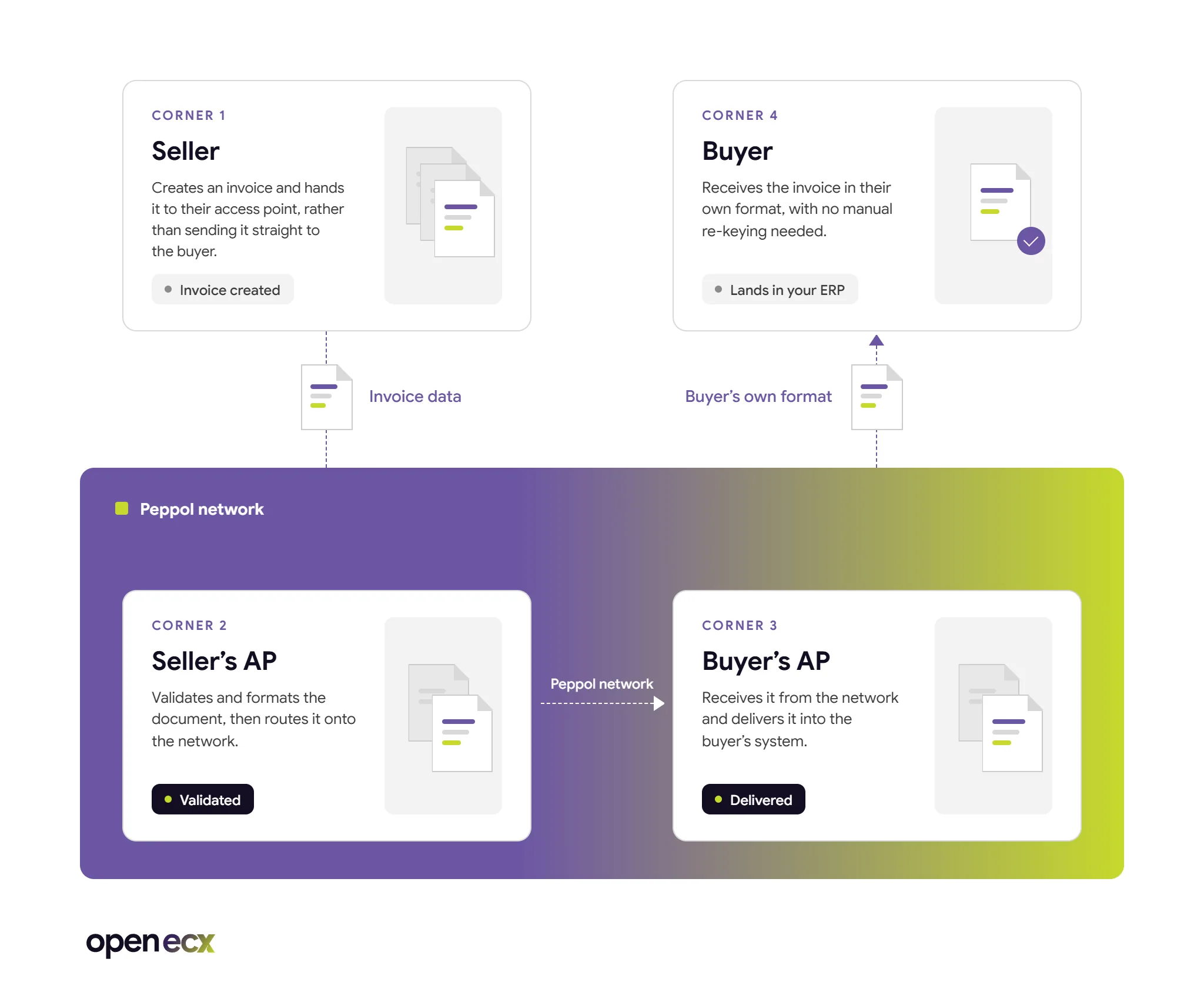
How Peppol e-invoicing actually works (the four corner model)
Peppol runs on what's called a four-corner model, and it's simpler than the name suggests:
- Corner 1: the sender, say, a supplier issuing an invoice
- Corner 2: the sender's Access Point, their connection to the network
- Corner 3: the receiver's Access Point
- Corner 4: the receiver, the business getting the invoice
Each Access Point handles the technical translation and delivery, so the sender and receiver never need matching software or a direct integration with each other. Send the document once, and the network routes it to the right place in the right format. That's the entire point of Peppol e-invoicing: one connection, endless trading partners.
What is a Peppol Access Point?
A Peppol Access Point is an accredited provider that plugs a business into the network. Think of it like a junction on the motorway; the slip road that gets you onto the main road everyone is using. Open ECX is one, recognised to connect businesses to Peppol and handle the sending, receiving, and format conversion behind the scenes. You don't build your own connection to every supplier or customer, you connect once, through an Access Point, and the network does the rest.
This matters because being "on Peppol" isn't something you bolt on yourself with a software update. It takes accreditation, ongoing compliance with the network's technical rules, and ideally, a provider already doing this for thousands of other businesses. Open ECX already connects 17,000+ businesses across invoicing, ordering, and statement reconciliation.
Why the UK is adopting Peppol, and what compliance actually means
The UK government has confirmed Peppol as the network underpinning its e-invoicing plans, ahead of the mandate expected from April 2029. Exact technical requirements remain subject to confirmation; HMRC and the Department for Business and Trade are running their joint consultation through 2026, with more detail expected at the Autumn Budget. What's already clear: Peppol connectivity is shaping up to be central to how UK businesses will exchange e-invoices, not an optional extra layered on top.
Peppol compliance, in practice, means your business can send and receive documents in the structured format the network, and eventually the mandate, requires. It doesn't mean ripping out your existing systems. Through an Access Point, your ERP keeps doing what it already does, the Access Point handles the translation.
Finding a business on the network: the Peppol Directory and Registry
Every business connected to Peppol gets listed in the Peppol Directory, sometimes called the Peppol Registry, a searchable record of who's reachable on the network and how. Trading partners use it to confirm a business is Peppol-ready before sending documents that way, similar in spirit to checking a sort code before a bank transfer. If you're Peppol-connected through an Access Point, you'll typically appear here automatically, no separate application needed.
Do you need your own Peppol ID?
A Peppol ID is the unique identifier that tells the network exactly which business a document is meant for, similar to how an email address routes a message to the right inbox. If you're connected through an Access Point, you're issued one as part of onboarding. You don't need to apply for it separately or manage it yourself; that's part of what the Access Point relationship covers. We'll walk through the practical steps of getting one, and what to do if a trading partner asks for yours, in a dedicated guide shortly.
Getting Peppol-ready yourself vs going through an Access Point
Technically, a business can pursue Peppol accreditation directly. In practice, almost nobody does, and here's why. Direct accreditation means managing the technical certification, keeping pace with network rule changes, and building integrations to match every trading partner's format quirks yourself. Most finance teams have better things to do with their time.
Going through an Access Point flips that. Open ECX handles the accreditation, the format conversion, and the ongoing compliance, so whatever format a document arrives in, PDF included, it gets transformed into what the network, and your ERP, needs. PDFs don't disappear once a business goes Peppol-ready, they still work, we just handle the conversion behind the scenes (more on why a PDF isn't a dead end for e-invoicing compliance). Nobody on your side needs to change how they currently send or receive anything.
Where this fits, and where to go next
Peppol is one piece of a bigger shift toward mandatory e-invoicing in the UK. If you want the fuller picture, you can read Preparing for the UK 2029 e-invoicing mandate, for the practical view. And if Peppol readiness has you thinking about the rest of your invoicing process, our Invoicing Automation page covers how that fits together.
Want to talk through what Peppol readiness looks like for your business specifically? Get in touch, we'll walk you through it.

