

I've spent the best part of 26 years delivering EDI and e-invoicing projects, and lately I keep running into the same argument: a PDF isn't a true e-invoice, so it doesn't count towards the mandate. Technically, that's correct. A PDF is built to be read by people, not exchanged automatically between systems. Strategically, this misses an opportunity.


The choice nobody's actually facing
Framed that way, it's tempting to collapse the whole thing into PDF or e-invoice. Pick one. But that's not the choice millions of businesses, large and small, are actually facing.
The real debate shouldn't be about the format a supplier happens to create. It should be about how that data gets into the interoperable network everyone is trying to build.
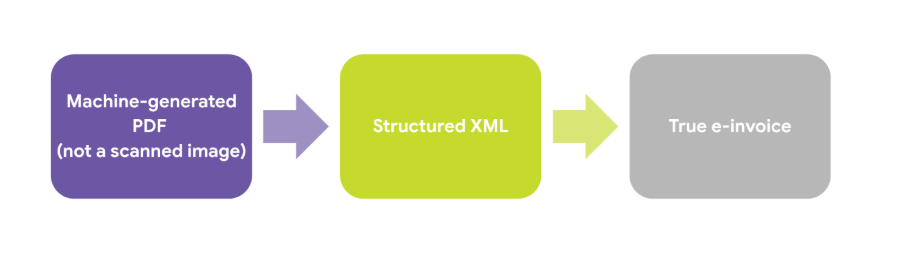
Here's the reality for millions of businesses:
Not every business can just switch
Underneath the "PDF isn't an e-invoice" argument sits a bigger assumption: that every business can immediately generate EN16931 XML, UBL or Peppol-ready XML straight out of its accounting system. For a lot of businesses, that's simply not true.
- SMEs
- Legacy ERP users
- Bespoke accounting systems
- Older finance packages overdue an upgrade
- Businesses with no XML capability built in at all
None of them have the time or the IT capacity to run a full EDI integration project, and expecting them to find it before 2029 isn't a plan, it's a hope.
What these businesses already do extremely well is produce a machine-generated PDF.
A machine-generated PDF is not a scan
That distinction gets lost more often than it should. A machine-generated PDF comes straight out of the sender's finance system, and the values inside it are already digital. There's no handwriting to misread, scan to clean up or image quality to fight. The data was born digital, it's just sitting in the wrong wrapper.
OCR is not the same problem, and it's not the answer
One thing that gets lumped in wrongly is treating OCR and machine-generated PDFs as the same challenge. They're not. OCR is trying to interpret an image, and its accuracy rises and falls with layout, fonts, scan quality, skew and however many ways a supplier's template happens to vary. No matter how good AI gets at reading pictures, it's still interpreting a document. Reading structured data straight out of a digital PDF is a different job, and a far easier one to get right.
Why EDI and OCR were never going to get us there
Most of the invoices that will need to comply with the UK's 2029 mandate arrive as machine-generated PDFs today, and they'll keep arriving that way. If the plan is to wait for all of them to generate compliant XML natively, we'll be waiting a long time past April 2029.
Historically, a business that couldn't generate compliant XML natively had two options, and neither scales to a mandate covering millions of businesses.
Traditional EDI is expensive, slow to implement, heavy on mapping and onboarding, and usually built point to point. It was never designed with SMEs in mind.
OCR is cheap, but the accuracy trade-off means a human still has to catch what it gets wrong, and that's a shaky foundation for a compliance mandate.
Machine-generated PDF to XML sits in the gap neither one covers. Accurate, because the data was already digital. Practical, because it doesn't ask a business to rebuild its finance stack first.
The bridge technology the mandate actually needs
I think machine-generated PDF to XML is what makes the UK's 2029 e-invoicing mandate realistic for the millions of businesses who can't generate compliant XML natively. Not a workaround, the thing that gets them there.
So the question isn't PDF versus XML. It's how we get millions of businesses ready for the mandate with the least stress and the least disruption to how they already work.
Where Open ECX comes in
That's the question I built Open ECX to answer. We don't ask our community of 17,000+ connected businesses to change how they invoice today. Whatever they already send, PDF included, we turn it into the structured data the network needs. No disruption, no lengthy integration project, whatever shape the final mandate rules turn out to take.

If you're staring down 2029 wondering whether your suppliers will ever generate compliant XML on their own, that's the wrong question. The right one is whether their PDFs can get there for them. They can.
It's not just suppliers who win
Everything so far has been about the sender, the business turning its own PDF into structured data. Fair question: what does the business on the other end, the buyer receiving that invoice, actually get out of it?
A good supply chain team wants its suppliers to get through the mandate with the least stress possible. That's reason enough on its own.
But there's a harder-nosed reason too. The AP automation business case for the buyer only pays off if every supplier invoice arrives in a form the system can act on straight away, not just some of them. A lengthy EDI project or an ERP upgrade slows that down and eats into the return. Machine-generated PDF to XML doesn't, because it works with whatever format suppliers are already sending.
Looking ahead, once that structured data is landing on the buyer's side, it's the foundation for:
- Automated invoice capture and validation
- Purchase order matching
- Automated approval workflows
- Exception management
- Touchless invoice processing
- Real-time visibility across accounts payable
- Faster invoice approval and payment
- Better supplier communication
- Fraud and duplicate invoice detection
- Automated statement reconciliation
- Supplier self-service
Put all of that together and it's full purchase-to-pay automation, not just faster invoice receipt.
The mandate is bigger than compliance
I don't think the point of this mandate is compliance for its own sake. The real prize is the digital foundation for the next generation of automated supply chains, and that's worth keeping in view while everyone's fixated on the 2029 deadline.
For buyers, that means one thing: getting as many supplier invoices into structured data as fast as possible. Machine-generated PDF to XML, delivered through a Peppol Access Point, is the pragmatic bridge for the millions of businesses that aren't ready for a full ERP or EDI project, and don't need to be.
Once that structured data is flowing in from the whole supply chain, everything covered above, matching, approvals, fraud detection, reconciliation, supplier self-service, stops being a wish list and starts being part of our new normal. And it doesn't stop at tidier invoicing. It's the foundation for supply chain orchestration across the whole network. That's the real goal.

