

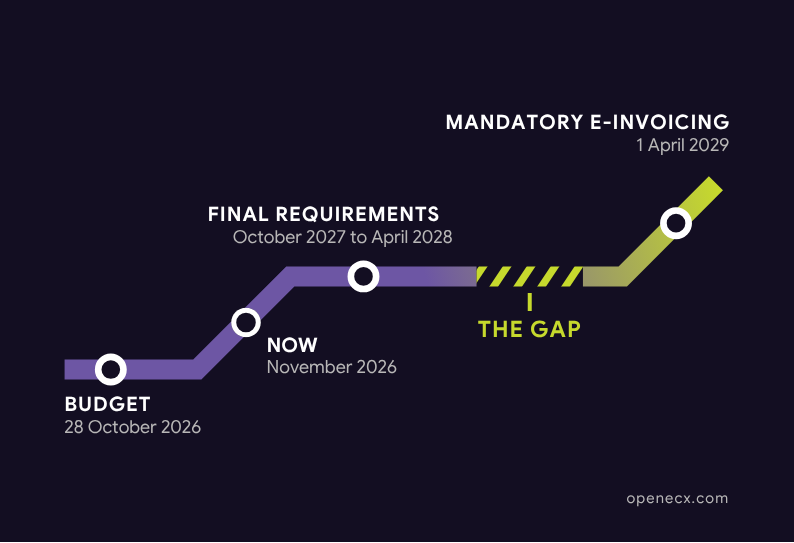
Last week, we covered what the Autumn Budget announced for e-invoicing. Today, we held our Next stop: 2029 webinar, where our founder Matthew Jones talked through what it all means in practice. Here are the questions that came up most, and Matthew's answers.
Does a PDF count as an e-invoice?
Not on its own. A PDF is a picture of an invoice that someone still has to read, key in or scan. An e-invoice is created, sent and received as structured data, so the buyer's system can read and process it automatically.
That doesn't mean you have to stop using PDFs. We can convert the PDFs you already work with into structured data, so they travel as e-invoices without interrupting your existing processes.
Is Peppol software I have to buy?
No. Peppol is an international network and a set of standards for exchanging documents like e-invoices. You connect to it through an access point, usually via your software provider, and you won't need to become one yourself.
How does an e-invoice get from one business to another?
Matthew walked through the four-corner model. The seller creates the invoice, and their access point checks it and sends it over the Peppol network. The buyer's access point receives it and delivers it straight into the buyer's system.
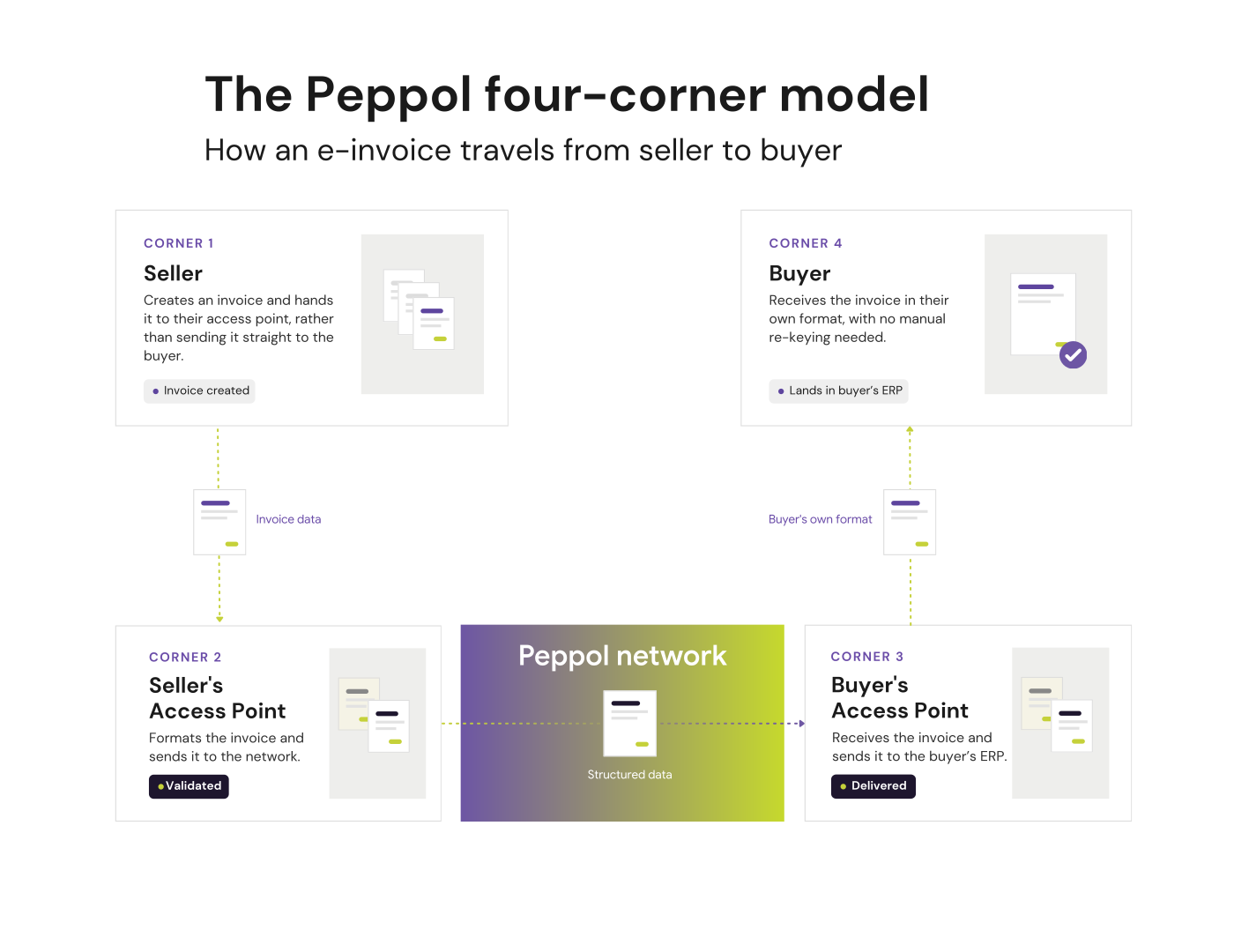
Each business only needs one connection to reach everyone else on the network.
Does HMRC get a copy of my invoices?
Not under the 2029 rules. E-invoices go business to business, and HMRC's role as the UK Peppol Authority is oversight, not collecting invoices. HMRC is also consulting on how e-invoice data could support tax in future, but says no decision has been taken. You can respond until 20 January 2027.
Can we keep using EDI?
Yes. You can keep using EDI alongside Peppol, as long as you can also send and receive e-invoices over the Peppol network. Guidance is due in autumn 2027.
What about cross-border invoices?
They're out of scope for the mandate. You can still agree to use e-invoices with overseas customers, and if you trade across Europe, ViDA and other countries' mandates are already on the way.
What's in it for my business, beyond compliance?
Less keying and chasing, fewer errors, faster payment and lower fraud risk. The roadmap says e-invoicing can more than halve the cost of processing paper, PDFs and other formats. It also finds small businesses spend 86 hours a year on average chasing late payments.
Matthew's advice is to make straight-through processing your KPI, and use the mandate as a catalyst for your wider P2P and O2C processes. And you don't have to wait for 2029 to start.
Where should I start?
Matthew suggested three building blocks:
- Readiness. Set a clear strategy now, rather than waiting for every detail.
- Ownership. Bring your suppliers, customers, AP and AR teams with you. It only works if they're ready too.
- Ambition. Treat compliance as the starting point, not the finish line.
For key dates, see our Budget 2026 blog. For a step-by-step plan, try our e-invoicing readiness checklist, or find more on our UK e-invoicing mandate hub.
Want to know where you stand?
Book your e-invoicing readiness check with our team. We're a certified Peppol access point and we provide the software too, so one team takes you from set-up to your first e-invoice.
Already an Open ECX customer? You're covered, and we'll keep you in step as the rules are confirmed.

